| [close] |
![]() |
| View pictures |
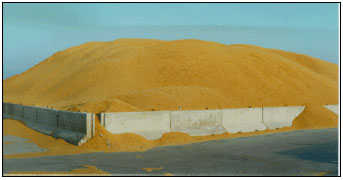
| Chia-Meng Rice Mill, Thailand
One of the largest rice mills in ASEAN opts for Cogeneration Commissioned: March 1997 Cogeneration Potential: 2.5 MV Energy source: Rice husk How does it work? The spent steam form the boiler is used for drying the paddy Flue gas - Combustion exhaust gas
|
| [close] |
| |
![]() |
| View pictures |
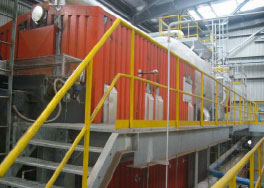
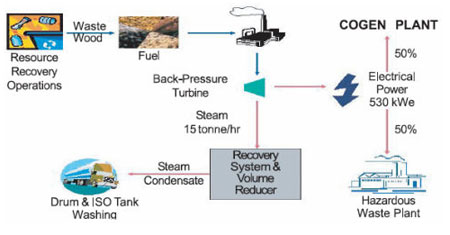
| ECO SWN Pvt Ltd., Singapore, a major waste management cooperation invests in cogeneration to meet its energy requirements
Commissioned: December, 2004 Cogeneration Potential: 0.53 MV Energy source: Wood wastes (beams, packing materials, boxes, sawdust) How does it work? Show me the money: |
![]() |
| [close] |
![]() |
| Run by two local companies (CTR/IS and VEKS/I), this is one of the largest district heating system of Denmark
Setup in 1984 How does it work? |
| [close] |
![]() |
|
Arvind Mills, Ahmedabad, India – A Textile manufacturer is one of the first Captive cogeneration plants in the country.
Setup in1997 Cogeneration Potential- 27 MW Energy source: Natural gas/ Naptha/ Agro-waste How does it work? The company cuts costs by meeting its power, heating and cooling requirements through cogeneration. The spent steam is used further for textile processing. The electricity is also used to run an effluent treatment plant that decreases their fresh water requirement by 85% Show me the money: Total investment - US$ 50million |
| [close] |
| |
![]() |
|
Svartsengi, Iceland
The Svartsengi cooperation started the first geothermal power plant in the world. The plant combines generation of electricity with production of hot water for district heating that serves 20,000 people Set up in - 1976 Cogeneration Potential: 46.4 MW 150 Mega joules per second (in the form of hot water) Energy source: Geothermal steam and Brine How does it work? The plant is built over an old lava field. It harnesses the energy of the open valves and fissures lining this geothermal fault line to run a Combined Heat and Power plant. Till date, 20 wells have been dug to trap steam vents and hot brine streams – two thirds sea water, running underground – to generate power. Part of the hot steam is used to generate electricity and the rest along with the brine is distributed to heat nine towns and an International airport. The effluent brine from the plant is disposed of into a surface pond, called the Blue Lagoon, popular to tourists and people suffering from psoriasis and other forms of eczema seeking therapeutic effects from the silica rich brine. |
| [close] |
![]() |
|
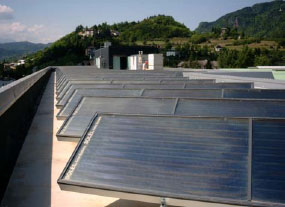
Solar Cooling on the roofs of ISI PERGRINE, a business center of Trento, Italy Energy source: Solar panels How does it work? Solar panels on the roof concentrate and store sun’s energy for winter heating and summer cooling of the two storey tall business center. The panels also meet the electricity needs of the Center. The heat concentrated by the solar panels is used to heat water which is circulated through the building during winters. In summertime, the hot water is used to run coolers which lower the temperature of the building’s ventilation. |
|
||||||||||||||||||||||||||||||||||||||||||